AI Calling Agent vs AI Voice Agent: What’s the Real Difference?
Most businesses today use AI to automate parts of their customer communication, especially phone calls. But as companies explore these technologies, one common confusion appears again and again:
“AI Calling Agent vs AI Voice Agent — aren’t they the same thing?”
They sound similar, and many companies market them interchangeably. But in real business operations, they serve different purposes and deliver different value.
This article clears the confusion once and for all — using real experience, real use cases, and practical examples from real businesses that rely on AI-powered communication systems every day.
Why This Comparison Matters
As someone who has worked with AI telephony systems, cloud contact centers, and outbound automation tools for years, I’ve seen businesses overspend simply because they didn’t understand the difference between the two.
Some ended up using a voice agent when they clearly needed a calling agent.
Others invested in the wrong tool entirely.
Understanding the difference between AI Calling Agent vs AI Voice Agent helps you:
>> Choose the right tool
>> Reduce cost
>> Improve customer experience
>> Automate the correct workflows
>> Avoid limitations later
Let’s break it down clearly.
What Is an AI Calling Agent?
An AI Calling Agent is built specifically for phone call automation — both outbound and inbound.
It dials numbers, holds conversations, responds intelligently, follows scripts, and completes tasks during the call.
Think of it as a virtual call center employee that can:
>> Make outbound calls like sales, reminders, follow-ups
>> Receive inbound calls like support or booking inquiries
>> Understand responses in real-time
>> Update your CRM
>> Trigger workflows
>> Confirm appointments, bookings, or payments
>> Qualify leads
>> Transfer calls to humans when needed
Real Example
A real estate company uses AI Calling Agents to call all new property inquiries within 30 seconds.
The agent asks questions like:
>> “What’s your budget?”
>> “Which area do you prefer?”
>>“ Are you planning to buy soon?”
Then it passes warm, verified leads to agents.
This is something a voice agent cannot do alone.
What Is an AI Voice Agent? (Clear, Expert-Friendly Definition)
An AI Voice Agent is designed for voice-based conversations, typically inside applications or devices. It doesn’t necessarily make or receive phone calls.
It’s more like a voice assistant — similar to Alexa, Google Assistant, or Siri.
A voice agent is used for:
>> IVR menus
>> Voice assistants inside apps
>> FAQ answering
>> Hands-free commands
>> Voice search
>> Customer self-service inside a mobile app or website
Real Example
A telecom company uses an AI Voice Agent inside their mobile app to allow customers to say:
>> “Recharge my number”
>> “What’s my data balance?”
>> “Show me my last bill”
It’s not calling anyone — it simply responds through voice.
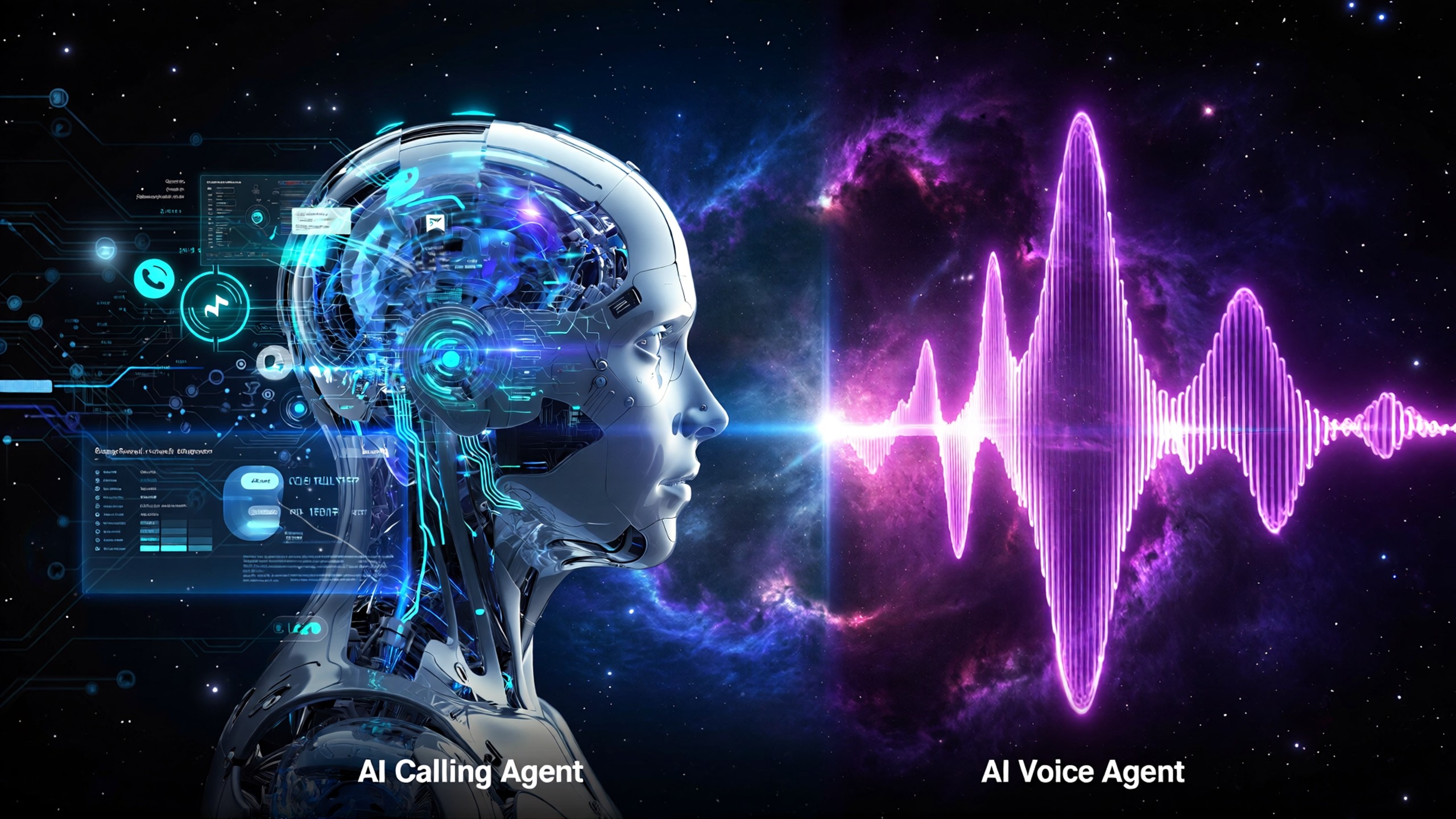
AI Calling Agent vs AI Voice Agent: Core Difference (Authoritative Summary)
Feature AI Calling Agent AI Voice Agent
Makes Phone Calls ✔ Yes ✖ No(unless separately integrated)
Receives Calls ✔ Yes ✖ Usually No
Acts like a Call Center Staff ✔ Yes ✖ No
Acts like a Voice Assistant ✖ No ✔ Yes
CRM Updating & Lead Qualification ✔ Strong ✖ Limited
Use While Driving / Voice Commands ✖ No ✔ Yes
Use Cases Sales, support, reminders, FAQs, IVR, app-based
bookings voice interactions
In short:
>> AI Calling Agent = phone-based automation
>> AI Voice Agent = voice-based assistant inside apps or devices
Who Should Use an AI Voice Agent?
You should choose an AI Voice Agent if your business needs:
✔ Voice assistants inside your website or app
✔ FAQ automation
✔ Simple voice-based navigation
✔ IVR improvements
✔ Self-service experiences
Best for:
>> Apps with customer portals
>> Telecom & utility providers
>> Banking apps
>> Tech companies
>> Automotive (voice commands)
>> Smart devices
Voice agents are great when the user is already inside your digital ecosystem.
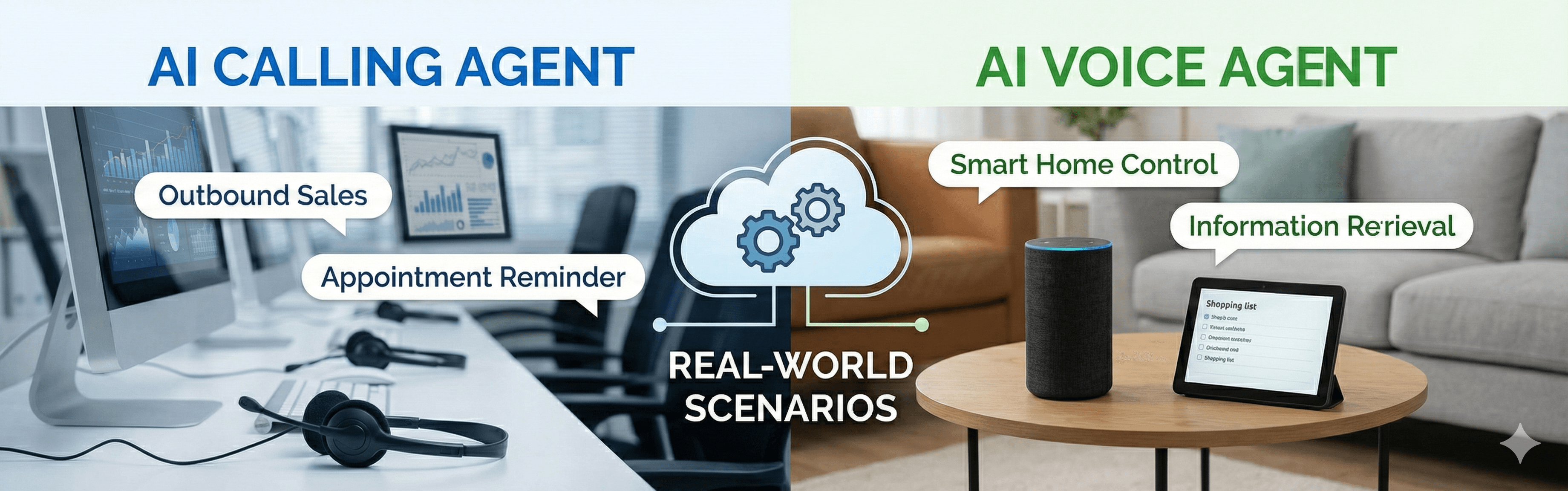
AI Calling Agent vs AI Voice Agent: Real-World Scenarios
Scenario 1: A Clinic Wants to Reduce Missed Appointments
Best choice: AI Calling Agent
It makes reminder calls, confirms availability, and reschedules if needed.
A voice agent inside the app cannot help if the patient does not open the app.
Scenario 2: A Telecom App Wants Hands-Free Navigation
Best choice: AI Voice Agent
Customers speak commands inside the app — no calling required.
Scenario 3: A Sales Team Needs Faster Lead Qualification
Best choice: AI Calling Agent
It calls leads instantly and identifies genuine buyers.
Scenario 4: A Bank Wants Voice-Based Self-Service
Best choice: AI Voice Agent
Users can speak commands while using the app.
Why Businesses Confuse the Two
Businesses often mix up AI Calling Agent vs AI Voice Agent because both:
>> Use natural language
>> Understand speech
>> Respond like humans
>> Sound similar in marketing
But once you break it down, their applications differ completely.
Most vendors don’t explain this clearly, which is why business owners end up purchasing the wrong tool.
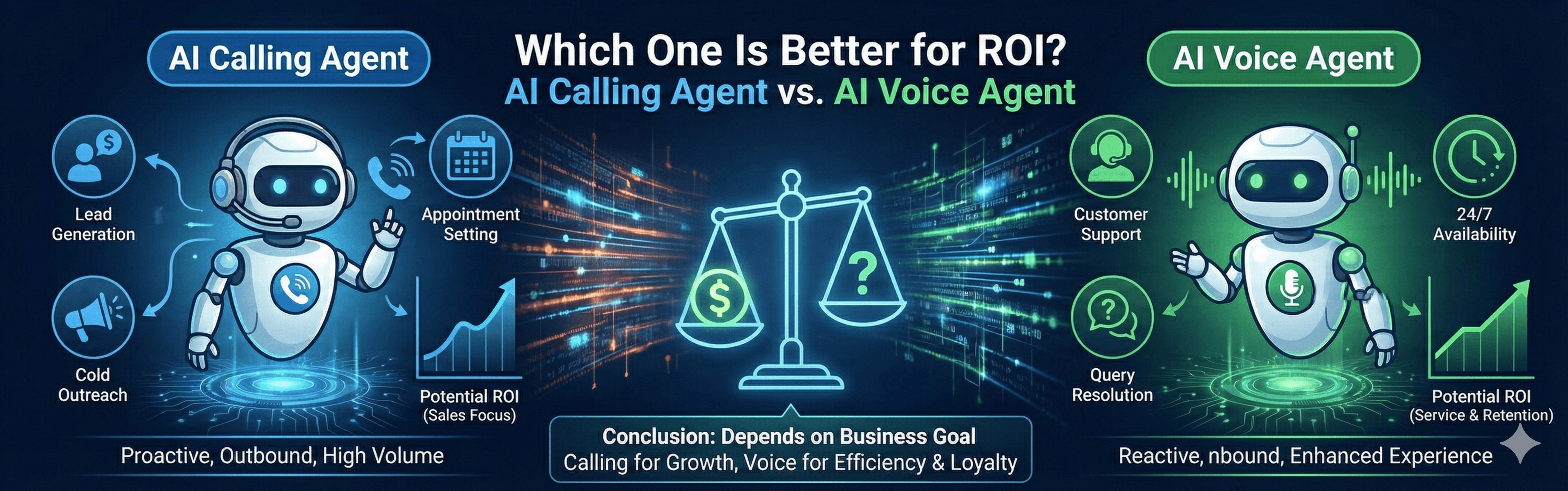
Which One Is Better for ROI?
From years of implementation experience:
AI Calling Agents usually generate higher ROI
because they replace expensive outbound calling teams and operate 24/7.
ROI comes from:
>> Lead qualification
>> Follow-ups
>> Renewals
>> Reminders
>> Payment recovery
>> Upselling
>> Customer callbacks
Meanwhile:
AI Voice Agents improve customer convenience
but don’t directly generate revenue.
They enhance user experience but are not revenue drivers on their own.
Security & Compliance Differences
AI Calling Agents must meet telephony laws, call recording policies, and consent requirements.
AI Voice Agents follow standard app privacy rules.
So if compliance is critical (banks, hospitals, insurance), choose carefully.
Final Verdict: Which Should You Use?
Here’s the simplest answer:
>> If your business makes phone calls → choose AI Calling Agent
>> If your business needs voice navigation or in-app voice assistance → choose AI Voice Agent
Both have their advantages, but they solve completely different problems.
Understanding the difference helps you invest in the right tool and avoid costly mistakes later.

Conclusion
The comparison AI Calling Agent vs AI Voice Agent is more than a technical debate — it affects customer experience, operational efficiency, and business growth.
To summarize:
>> AI Calling Agent = A virtual calling employee
>> AI Voice Agent = A virtual voice assistant
Once you know what each does, choosing becomes easy.
If you’re planning to implement either of these systems, feel free to ask — I can help you with:
✔ Use case evaluation
✔ Cost planning
✔ Tech stack suggestions
✔ Vendor selection
✔ Implementation roadmap
To explore related insights, you may also find these articles helpful:
Frequently Asked Questions
Here are answers to some frequently asked questions. If your question isn’t listed, please contact us. We’re happy to assist!