Application Modernization Strategies in 2025: A Complete Guide
In 2025, digital agility is no longer optional—it is a core requirement for survival and growth. Businesses across industries are facing increasing pressure to deliver faster, more reliable, and more personalized digital experiences. At the same time, many organizations are still running critical operations on legacy applications that were built decades ago for a completely different technological era.
These legacy systems often struggle to meet modern demands. They are expensive to maintain, difficult to scale, vulnerable to security threats, and slow to adapt to changing business needs. As competition intensifies and customer expectations rise, application modernization has become a strategic imperative rather than a discretionary IT initiative.
Application modernization in 2025 is not simply about moving software to the cloud or rewriting code. It is about rethinking how applications support business goals, enable innovation, and create long-term value. Organizations that modernize successfully gain greater resilience, operational efficiency, and the ability to innovate faster than their competitors.
This guide provides a comprehensive overview of application modernization in 2025—what it is, why it matters, the most effective modernization strategies, emerging trends, best practices, and how businesses can choose the right approach for long-term success.
Who This Guide Is For
This guide is written for professionals who are directly responsible for technology and business outcomes, including:
CIOs, CTOs, and IT Directors
Heads of Engineering and Product Leaders
Digital Transformation and Enterprise Architects
Business leaders evaluating modernization ROI
By reading this guide, you will:
Understand what application modernization truly means in 2025
Learn the most effective modernization strategies and when to use them
Avoid common modernization mistakes that increase cost and risk
Gain clarity on how modernization impacts business KPIs
Make informed decisions that balance speed, cost, and long-term value
This is not a theoretical overview. It is a practical decision-making resource grounded in real-world enterprise modernization challenges.
What Is Application Modernization?
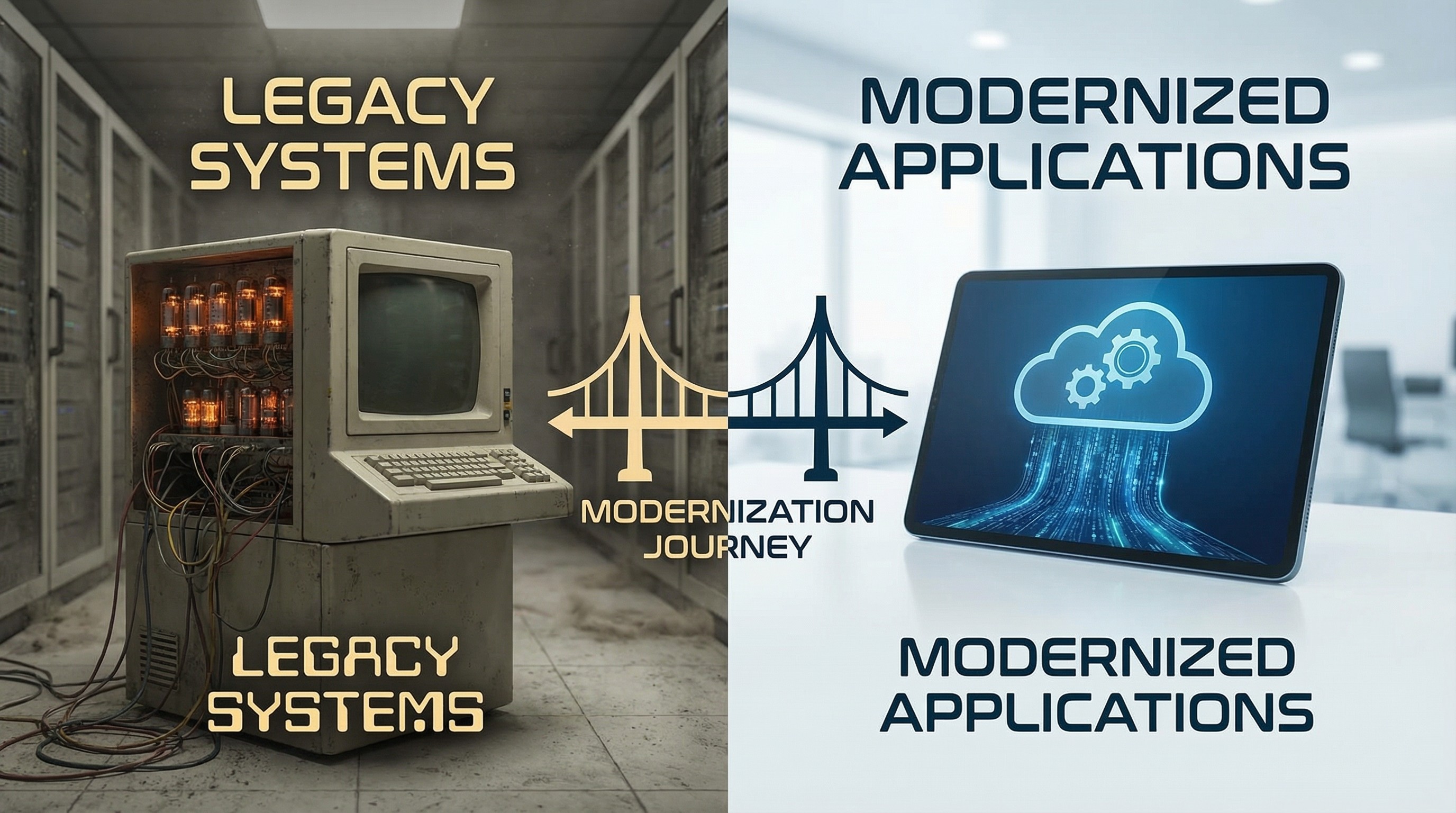
Application modernization is the process of transforming existing software applications to align with modern technology standards, business requirements, and user expectations—while preserving the business logic that continues to deliver value.
In 2025, modernization typically includes a combination of:
Migrating applications to public or hybrid cloud platforms
Breaking monolithic applications into modular or microservices-based architectures
Enabling API-driven integrations
Automating development, testing, and deployment through DevOps
Embedding security and compliance into the development lifecycle
Improving observability, performance, and resilience
Crucially, modernization is not always about rebuilding from scratch. In fact, the most successful organizations modernize incrementally, choosing the least disruptive approach that delivers the highest business impact.
Why Application Modernization Is Critical in 2025
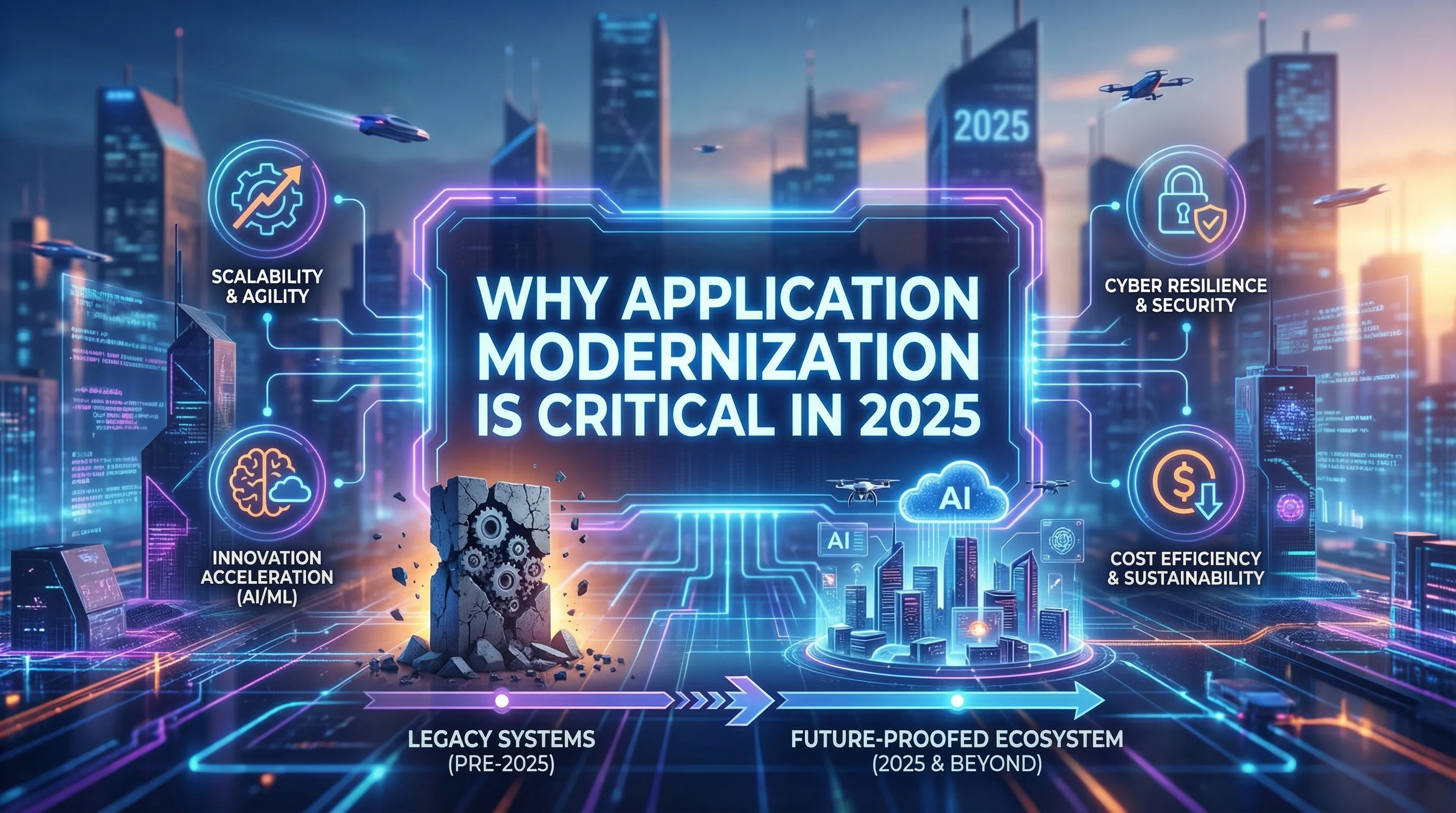
Legacy applications were designed for stable, predictable environments with limited integration requirements. Today’s business environment is dynamic, interconnected, and highly competitive. As organizations scale, legacy systems increasingly become constraints.
Key Challenges of Legacy Applications
1. Rising Operational Costs
Legacy systems often require specialized infrastructure and skills, making them expensive to maintain and difficult to upgrade.
2. Limited Scalability and Performance
Traditional architectures struggle with fluctuating demand, leading to slow performance and poor user experiences.
3. Security and Compliance Risks
Older applications lack modern security controls, increasing exposure to cyber threats and regulatory violations.
4. Poor Integration Capabilities
Legacy systems were not built to integrate easily with SaaS platforms, APIs, and data ecosystems.
5. Slow Innovation and Time-to-Market
Even small changes can take weeks or months, slowing business responsiveness.
6. Declining Developer Productivity
Outdated technologies reduce development velocity and make talent acquisition difficult.
Modernized applications address these challenges by enabling faster development, stronger security, and seamless integration with modern digital ecosystems.
Application Modernization as a Business Strategy
In 2025, leading organizations no longer treat application modernization as an isolated IT project. Instead, they view it as a business strategy that directly impacts:
Revenue growth
Customer experience
Operational efficiency
Risk management
Innovation velocity
Modernization decisions are increasingly driven by business outcomes, not technology trends. The goal is to enable faster decision-making, continuous improvement, and long-term resilience.
Key Application Modernization Strategies in 2025
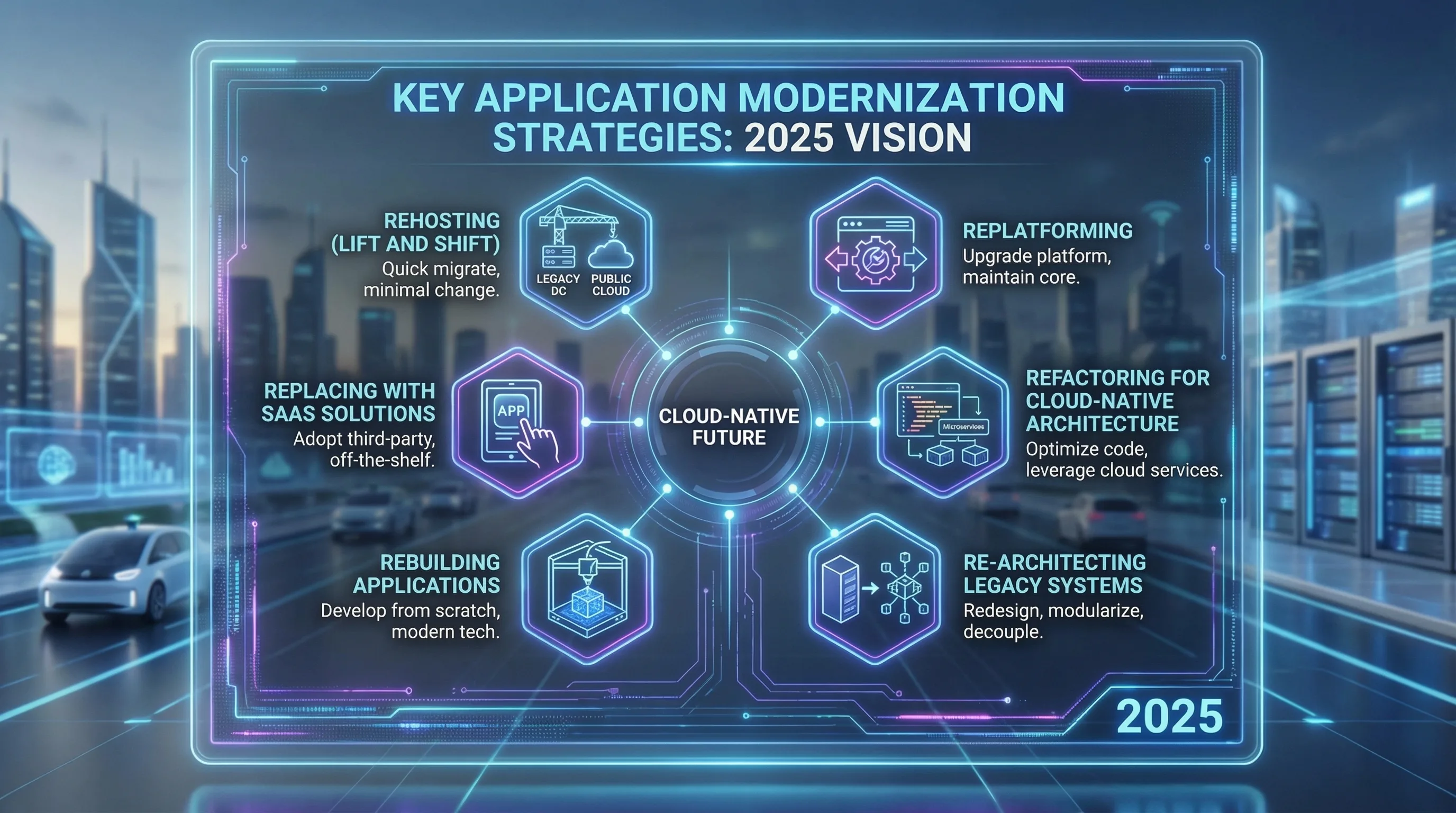
There is no single “best” modernization strategy. The right approach depends on application value, complexity, risk tolerance, and long-term goals. Most enterprises use a hybrid approach, applying different strategies to different applications.
Below are the most effective application modernization strategies in 2025.
1. Rehosting (Lift and Shift)
Rehosting involves moving applications from on-premise infrastructure to cloud environments with minimal or no changes to the application code.
When Rehosting Makes Sense
You need rapid cloud migration
Budget and timelines are constrained
Applications are stable and low-risk
Immediate infrastructure cost reduction is the goal
Benefits
Fastest path to cloud adoption
Reduced hardware and data center costs
Improved availability and disaster recovery
Limitations
Limited performance improvements
Does not leverage cloud-native capabilities
Rehosting is often a first step, not a final modernization state.
2. Replatforming
Replatforming introduces targeted optimizations during cloud migration, such as upgrading databases or middleware while keeping the core application intact.
When to Choose Replatforming
You need moderate performance and scalability gains
Risk needs to remain low
You want to prepare for future modernization
Benefits
Better performance than rehosting
Minimal disruption to business operations
Cost-effective modernization
Replatforming strikes a balance between speed, cost, and improvement.
3. Refactoring for Cloud-Native Architecture
Refactoring involves redesigning applications to use cloud-native principles such as microservices, containers, and managed services.
When Refactoring Is the Right Choice
High scalability and resilience are required
The application is business-critical
Long-term agility is a priority
Benefits
Elastic scalability and fault tolerance
Faster development and deployment cycles
Improved reliability and maintainability
Challenges
Higher upfront investment
Requires mature engineering and DevOps practices
Refactoring delivers the highest long-term value but requires careful planning.
4. Re-Architecting Legacy Systems
Re-architecting focuses on redesigning application structure—often decomposing monoliths into modular or service-based components.
When to Re-Architect
Architecture limits innovation
Business logic remains valuable
Integration with modern platforms is essential
Benefits
Improved flexibility and maintainability
Easier API-driven integrations
Reduced long-term technical debt
Re-architecting enables modernization without a full rebuild.
5. Rebuilding Applications
Rebuilding means creating a new application from scratch using modern frameworks and architectures.
When Rebuilding Is Necessary
Legacy code is unstable or obsolete
Business requirements have changed significantly
The application no longer aligns with strategy
Benefits
Clean, future-ready codebase
Optimized security and performance
Risks
Higher cost and longer timelines
Requires strong change management
Rebuilding should be reserved for applications where incremental modernization is no longer viable.
6. Replacing with SaaS Solutions
For non-core applications, replacing legacy systems with commercial SaaS platforms is often the most efficient option.
When SaaS Replacement Works Best
The application is not a competitive differentiator
Mature SaaS solutions are available
Benefits
Rapid deployment
Lower maintenance costs
Built-in updates and compliance
This allows teams to focus internal resources on innovation.
Decision Guide: Choosing the Right Strategy
Business Need Recommended Strategy
Fast cloud migration Rehosting
Moderate improvements Replatforming
High scalability & agility Refactoring
Innovation blocked by monolith Re-Architecting
Obsolete legacy code Rebuilding
Non-core function SaaS Replacement
How Synthlane Supports These Strategies:
Synthlane’s Application Modernization Services help businesses assess legacy applications, choose the right modernization approach, and execute each strategy
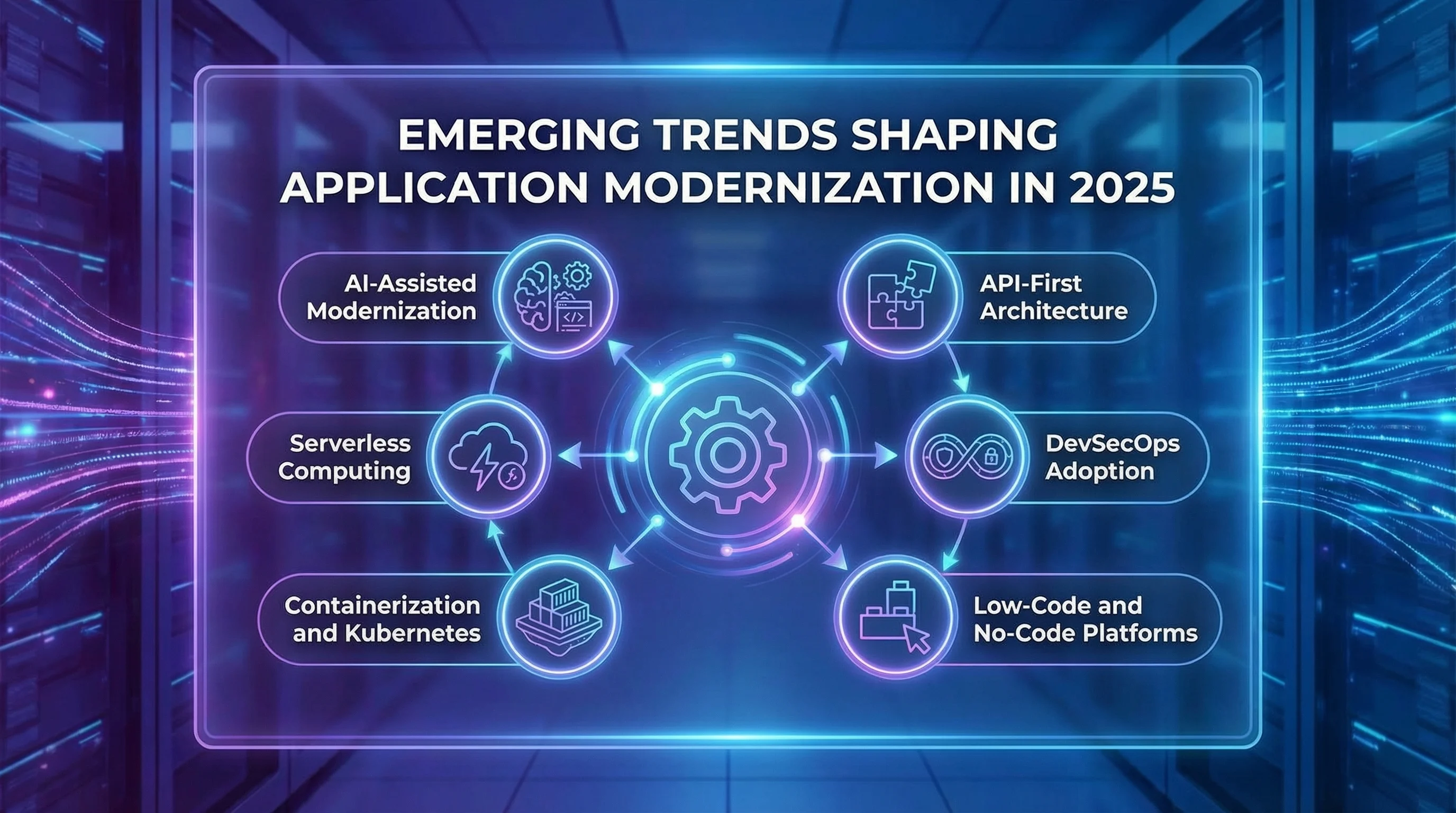
Emerging Trends Shaping Application Modernization in 2025
Modernization strategies continue to evolve alongside technology.
Key Trends Include:
AI-Assisted Modernization
AI tools analyze codebases, identify dependencies, and automate testing and refactoring.
API-First Architecture
APIs enable interoperability, ecosystem growth, and faster innovation.
DevSecOps Adoption
Security is embedded throughout the development lifecycle.
Low-Code and No-Code Platforms
Accelerate delivery and empower business teams.
Containerization and Kubernetes
Enable scalable, portable deployments.
Serverless Computing
Reduce infrastructure management and operational overhead.
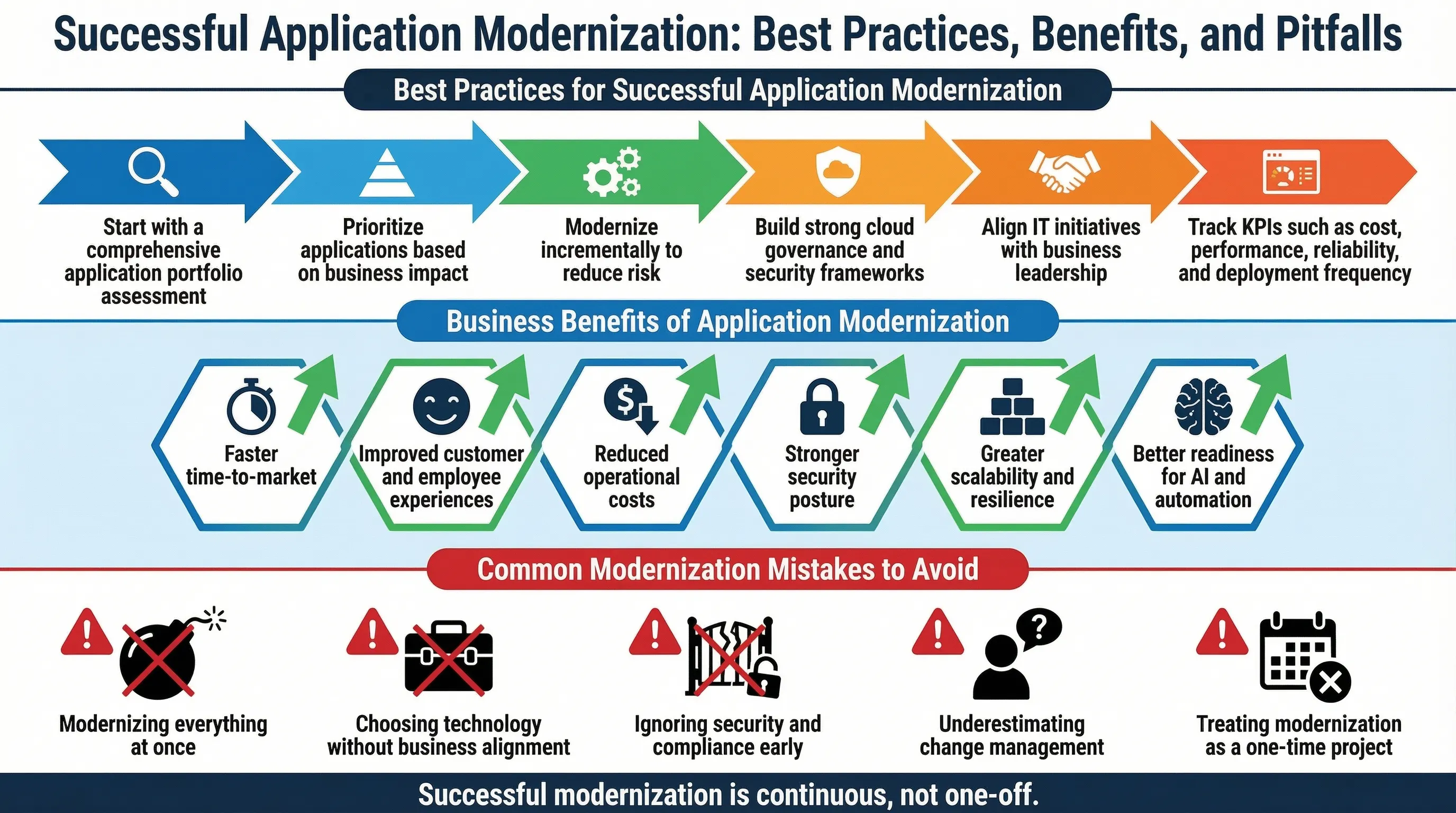
Best Practices for Successful Application Modernization
Start with a comprehensive application portfolio assessment
Prioritize applications based on business impact
Modernize incrementally to reduce risk
Build strong cloud governance and security frameworks
Align IT initiatives with business leadership
Track KPIs such as cost, performance, reliability, and deployment frequency
Business Benefits of Application Modernization
Organizations that modernize effectively typically experience:
Faster time-to-market
Improved customer and employee experiences
Reduced operational costs
Stronger security posture
Greater scalability and resilience
Better readiness for AI and automation
Common Modernization Mistakes to Avoid
Modernizing everything at once
Choosing technology without business alignment
Ignoring security and compliance early
Underestimating change management
Treating modernization as a one-time project
Successful modernization is continuous, not one-off.
Application Modernization Is Not Just a Technology Upgrade — It’s a Business Transformation
Application modernization in 2025 is a strategic investment in resilience, innovation, and long-term growth. Organizations that modernize thoughtfully—balancing speed, cost, and value—are better positioned to adapt to change and outperform competitors.
By choosing the right modernization strategies and following best practices, businesses can transform legacy systems into future-ready platforms that support continuous innovation.
Who This Guide Is For
This guide is written for professionals who are directly responsible for technology and business outcomes, including:
CIOs, CTOs, and IT Directors
Heads of Engineering and Product Leaders
Digital Transformation and Enterprise Architects
Business leaders evaluating modernization ROI
By reading this guide, you will:
Understand what application modernization truly means in 2025
Learn the most effective modernization strategies and when to use them
Avoid common modernization mistakes that increase cost and risk
Gain clarity on how modernization impacts business KPIs
Make informed decisions that balance speed, cost, and long-term value
This is not a theoretical overview. It is a practical decision-making resource grounded in real-world enterprise modernization challenges.
What Is Application Modernization?
Application modernization is the process of transforming existing software applications to align with modern technology standards, business requirements, and user expectations—while preserving the business logic that continues to deliver value.
In 2025, modernization typically includes a combination of:
Migrating applications to public or hybrid cloud platforms
Breaking monolithic applications into modular or microservices-based architectures
Enabling API-driven integrations
Automating development, testing, and deployment through DevOps
Embedding security and compliance into the development lifecycle
Improving observability, performance, and resilience
Crucially, modernization is not always about rebuilding from scratch. In fact, the most successful organizations modernize incrementally, choosing the least disruptive approach that delivers the highest business impact.
Why Application Modernization Is Critical in 2025
Legacy applications were designed for stable, predictable environments with limited integration requirements. Today’s business environment is dynamic, interconnected, and highly competitive. As organizations scale, legacy systems increasingly become constraints.
Key Challenges of Legacy Applications
1. Rising Operational Costs
Legacy systems often require specialized infrastructure and skills, making them expensive to maintain and difficult to upgrade.
2. Limited Scalability and Performance
Traditional architectures struggle with fluctuating demand, leading to slow performance and poor user experiences.
3. Security and Compliance Risks
Older applications lack modern security controls, increasing exposure to cyber threats and regulatory violations.
4. Poor Integration Capabilities
Legacy systems were not built to integrate easily with SaaS platforms, APIs, and data ecosystems.
5. Slow Innovation and Time-to-Market
Even small changes can take weeks or months, slowing business responsiveness.
6. Declining Developer Productivity
Outdated technologies reduce development velocity and make talent acquisition difficult.
Modernized applications address these challenges by enabling faster development, stronger security, and seamless integration with modern digital ecosystems.
Application Modernization as a Business Strategy
In 2025, leading organizations no longer treat application modernization as an isolated IT project. Instead, they view it as a business strategy that directly impacts:
Revenue growth
Customer experience
Operational efficiency
Risk management
Innovation velocity
Modernization decisions are increasingly driven by business outcomes, not technology trends. The goal is to enable faster decision-making, continuous improvement, and long-term resilience.
Key Application Modernization Strategies in 2025
There is no single “best” modernization strategy. The right approach depends on application value, complexity, risk tolerance, and long-term goals. Most enterprises use a hybrid approach, applying different strategies to different applications.
Below are the most effective application modernization strategies in 2025.
1. Rehosting (Lift and Shift)
Rehosting involves moving applications from on-premise infrastructure to cloud environments with minimal or no changes to the application code.
When Rehosting Makes Sense
You need rapid cloud migration
Budget and timelines are constrained
Applications are stable and low-risk
Immediate infrastructure cost reduction is the goal
Benefits
Fastest path to cloud adoption
Reduced hardware and data center costs
Improved availability and disaster recovery
Limitations
Limited performance improvements
Does not leverage cloud-native capabilities
Rehosting is often a first step, not a final modernization state.
2. Replatforming
Replatforming introduces targeted optimizations during cloud migration, such as upgrading databases or middleware while keeping the core application intact.
When to Choose Replatforming
You need moderate performance and scalability gains
Risk needs to remain low
You want to prepare for future modernization
Benefits
Better performance than rehosting
Minimal disruption to business operations
Cost-effective modernization
Replatforming strikes a balance between speed, cost, and improvement.
3. Refactoring for Cloud-Native Architecture
Refactoring involves redesigning applications to use cloud-native principles such as microservices, containers, and managed services.
When Refactoring Is the Right Choice
High scalability and resilience are required
The application is business-critical
Long-term agility is a priority
Benefits
Elastic scalability and fault tolerance
Faster development and deployment cycles
Improved reliability and maintainability
Challenges
Higher upfront investment
Requires mature engineering and DevOps practices
Refactoring delivers the highest long-term value but requires careful planning.
4. Re-Architecting Legacy Systems
Re-architecting focuses on redesigning application structure—often decomposing monoliths into modular or service-based components.
When to Re-Architect
Architecture limits innovation
Business logic remains valuable
Integration with modern platforms is essential
Benefits
Improved flexibility and maintainability
Easier API-driven integrations
Reduced long-term technical debt
Re-architecting enables modernization without a full rebuild.
5. Rebuilding Applications
Rebuilding means creating a new application from scratch using modern frameworks and architectures.
When Rebuilding Is Necessary
Legacy code is unstable or obsolete
Business requirements have changed significantly
The application no longer aligns with strategy
Benefits
Clean, future-ready codebase
Optimized security and performance
Risks
Higher cost and longer timelines
Requires strong change management
Rebuilding should be reserved for applications where incremental modernization is no longer viable.
6. Replacing with SaaS Solutions
For non-core applications, replacing legacy systems with commercial SaaS platforms is often the most efficient option.
When SaaS Replacement Works Best
The application is not a competitive differentiator
Mature SaaS solutions are available
Benefits
Rapid deployment
Lower maintenance costs
Built-in updates and compliance
This allows teams to focus internal resources on innovation.
Decision Guide: Choosing the Right Strategy
Business Need Recommended Strategy
Fast cloud migration Rehosting
Moderate improvements Replatforming
High scalability & agility Refactoring
Innovation blocked by monolith Re-Architecting
Obsolete legacy code Rebuilding
Non-core function SaaS Replacement
How Synthlane Supports These Strategies:
Synthlane’s Application Modernization Services help businesses assess legacy applications, choose the right modernization approach, and execute each strategy
Emerging Trends Shaping Application Modernization in 2025
Modernization strategies continue to evolve alongside technology.
Key Trends Include:
AI-Assisted Modernization
AI tools analyze codebases, identify dependencies, and automate testing and refactoring.
API-First Architecture
APIs enable interoperability, ecosystem growth, and faster innovation.
DevSecOps Adoption
Security is embedded throughout the development lifecycle.
Low-Code and No-Code Platforms
Accelerate delivery and empower business teams.
Containerization and Kubernetes
Enable scalable, portable deployments.
Serverless Computing
Reduce infrastructure management and operational overhead.
Best Practices for Successful Application Modernization
Start with a comprehensive application portfolio assessment
Prioritize applications based on business impact
Modernize incrementally to reduce risk
Build strong cloud governance and security frameworks
Align IT initiatives with business leadership
Track KPIs such as cost, performance, reliability, and deployment frequency
Business Benefits of Application Modernization
Organizations that modernize effectively typically experience:
Faster time-to-market
Improved customer and employee experiences
Reduced operational costs
Stronger security posture
Greater scalability and resilience
Better readiness for AI and automation
Common Modernization Mistakes to Avoid
Modernizing everything at once
Choosing technology without business alignment
Ignoring security and compliance early
Underestimating change management
Treating modernization as a one-time project
Successful modernization is continuous, not one-off.
Application Modernization Is Not Just a Technology Upgrade — It’s a Business Transformation
Application modernization in 2025 is a strategic investment in resilience, innovation, and long-term growth. Organizations that modernize thoughtfully—balancing speed, cost, and value—are better positioned to adapt to change and outperform competitors.
By choosing the right modernization strategies and following best practices, businesses can transform legacy systems into future-ready platforms that support continuous innovation.
Frequently Asked Questions
Here are answers to some frequently asked questions. If your question isn’t listed, please contact us. We’re happy to assist!
1.
Is application modernization necessary for all businesses?
1.
Is application modernization necessary for all businesses?
2.
Why is legacy application modernization important?
2.
Why is legacy application modernization important?
3.
What are the top benefits of modernizing legacy software?
3.
What are the top benefits of modernizing legacy software?
4.
How do I know when it's time to modernize an application?
4.
How do I know when it's time to modernize an application?
5.
What are the common strategies for application modernization?