How Businesses Are Using AI Automation to Reduce Costs

In today’s highly competitive business environment, cost efficiency is no longer just about cutting expenses—it’s about working smarter, faster, and at scale. This is where AI automation is transforming how modern businesses operate.
From customer support and sales to operations, HR, and marketing, organizations across industries are adopting AI-powered automation to reduce operational costs, improve efficiency, and increase profitability—without compromising quality or customer experience.
This article explores how businesses are using AI automation to reduce costs, where the biggest savings come from, real-world outcomes companies are seeing, and why decision-makers are increasingly investing in AI-driven solutions.
In today’s highly competitive business environment, cost efficiency is no longer just about cutting expenses—it’s about working smarter, faster, and at scale. This is where AI automation is transforming how modern businesses operate.
From customer support and sales to operations, HR, and marketing, organizations across industries are adopting AI-powered automation to reduce operational costs, improve efficiency, and increase profitability—without compromising quality or customer experience.
This article explores how businesses are using AI automation to reduce costs, where the biggest savings come from, real-world outcomes companies are seeing, and why decision-makers are increasingly investing in AI-driven solutions.
What Is AI Automation?
AI automation combines artificial intelligence with business process automation to perform tasks that traditionally required human effort—but faster, more accurately, and at a significantly lower cost.
Unlike basic rule-based automation, AI automation can:
Understand natural language
Learn from historical and real-time data
Make contextual decisions
Improve performance continuously over time
This makes AI automation ideal for high-volume, repetitive, and time-consuming processes where manual execution becomes expensive, slow, and error-prone.
What Is AI Automation?
AI automation combines artificial intelligence with business process automation to perform tasks that traditionally required human effort—but faster, more accurately, and at a significantly lower cost.
Unlike basic rule-based automation, AI automation can:
Understand natural language
Learn from historical and real-time data
Make contextual decisions
Improve performance continuously over time
This makes AI automation ideal for high-volume, repetitive, and time-consuming processes where manual execution becomes expensive, slow, and error-prone.
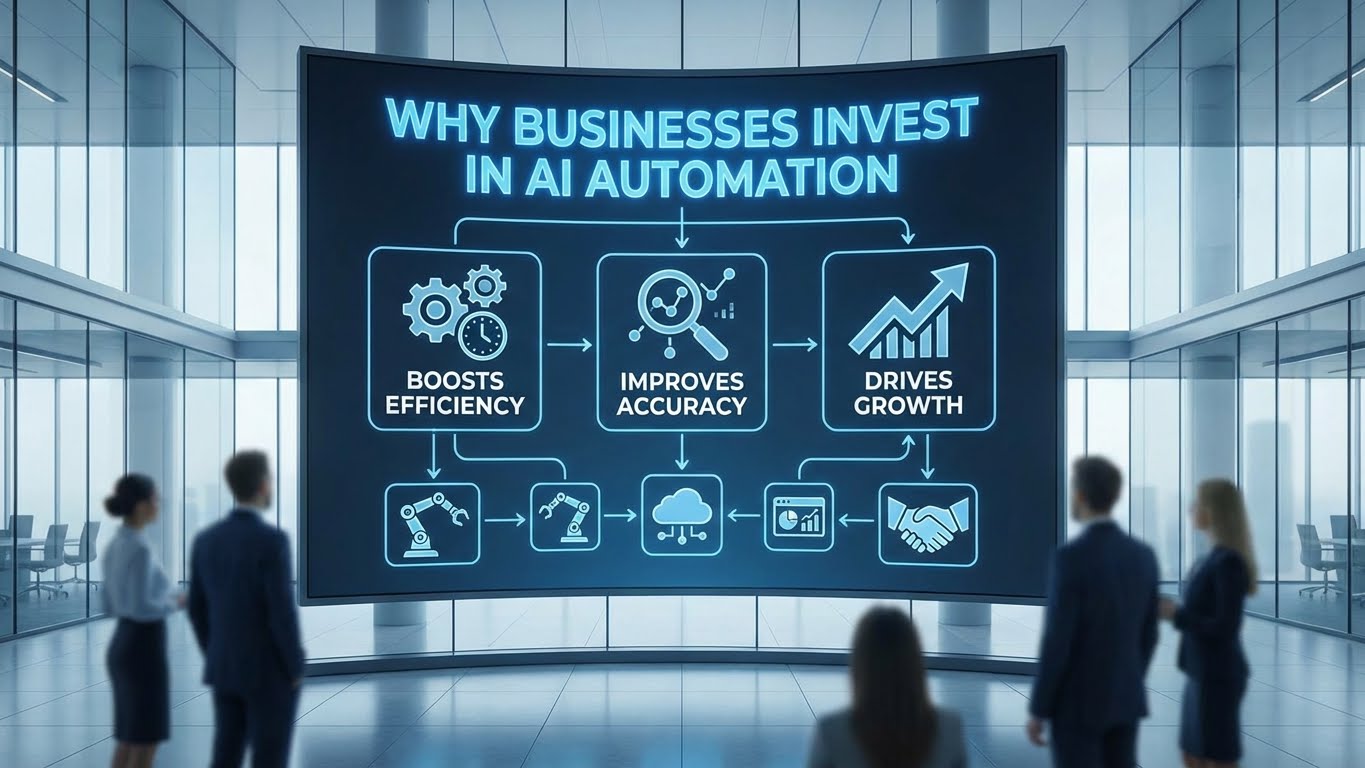
Why Businesses Are Investing in AI Automation
The shift toward AI-driven business automation is driven by clear, measurable outcomes:
Rising labor and operational costs
Increasing customer expectations for speed and availability
Pressure to scale operations without expanding teams
Growing need for real-time, data-driven decision-making
For business leaders, AI automation is no longer an experiment—it’s a proven cost-reduction and growth strategy with predictable ROI.
Why Businesses Are Investing in AI Automation
The shift toward AI-driven business automation is driven by clear, measurable outcomes:
Rising labor and operational costs
Increasing customer expectations for speed and availability
Pressure to scale operations without expanding teams
Growing need for real-time, data-driven decision-making
For business leaders, AI automation is no longer an experiment—it’s a proven cost-reduction and growth strategy with predictable ROI.
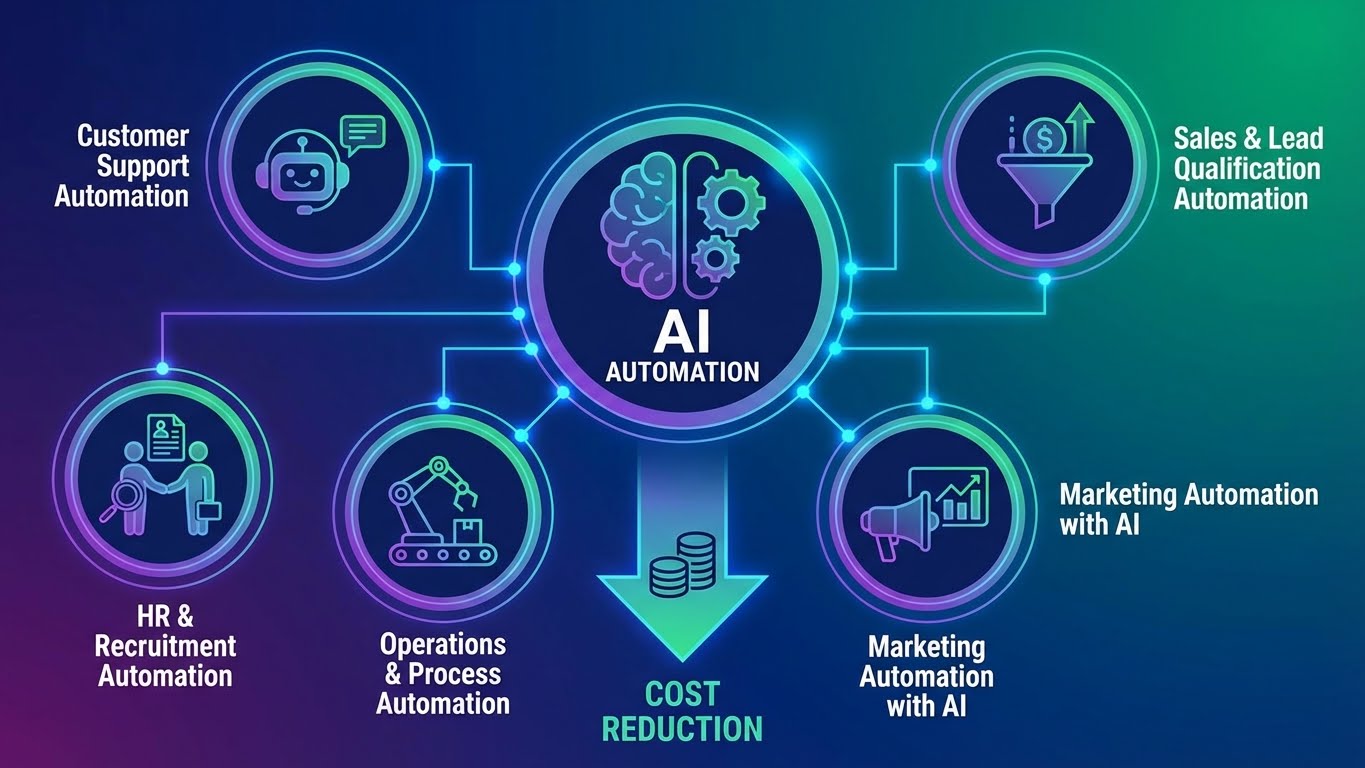
Key Areas Where AI Automation Reduces Costs
1. Customer Support Automation
Customer support is one of the largest recurring cost centers for many businesses. AI automation significantly reduces these costs by handling routine interactions automatically.
How businesses use it:
AI chatbots for FAQs and issue resolution
AI voice agents to handle inbound calls
Automated ticket categorization, routing, and prioritization
Cost impact:
Fewer human agents required for repetitive queries
Reduced average handling time
24/7 support without overtime or shift costs
Real impact: Many businesses report a 30–60% reduction in customer support costs after implementing AI automation for first-level interactions.
2. Sales & Lead Qualification Automation
Sales teams often spend valuable time chasing unqualified leads and managing manual follow-ups. AI automation removes this inefficiency.
How businesses use it:
AI calling agents for outbound lead qualification
Automated follow-up calls, reminders, and nurturing
AI-driven lead scoring and intelligent routing
Cost impact:
Reduced cost per lead
Higher conversion rates
Sales teams focus only on high-intent prospects
The result is lower customer acquisition costs (CAC) and shorter sales cycles.
3. Operations & Process Automation
Internal operations are full of repetitive workflows that quietly drain time, money, and resources. AI-powered process automation eliminates these hidden costs.
Common use cases include:
Invoice processing and data extraction
Document classification and validation
Workflow approvals with AI-based decision-making
Cost impact:
Fewer manual errors and rework
Faster processing times
Reduced dependency on large operations teams
Organizations often achieve major reductions in processing costs while improving accuracy and turnaround time.
4. HR & Recruitment Automation
Hiring and HR operations typically involve high manual effort, long cycle times, and administrative overhead.
How AI automation helps:
Resume screening and candidate shortlisting
Automated interview scheduling and coordination
Employee query handling via AI assistants
Cost impact:
Shorter recruitment cycles
Lower HR operational costs
More consistent and unbiased hiring processes
HR teams can focus on strategy, culture, and retention instead of administration.
5. Marketing Automation with AI
Marketing budgets are often wasted on poorly targeted campaigns. AI automation ensures marketing spend delivers measurable returns.
Common applications:
AI-driven ad optimization and bidding
Personalized email and messaging campaigns
Predictive customer segmentation and targeting
Cost impact:
Higher ROI on ad spend
Reduced manual campaign management
Improved engagement and conversion rates
AI ensures marketing budgets are allocated where performance is strongest.
Key Areas Where AI Automation Reduces Costs
1. Customer Support Automation
Customer support is one of the largest recurring cost centers for many businesses. AI automation significantly reduces these costs by handling routine interactions automatically.
How businesses use it:
AI chatbots for FAQs and issue resolution
AI voice agents to handle inbound calls
Automated ticket categorization, routing, and prioritization
Cost impact:
Fewer human agents required for repetitive queries
Reduced average handling time
24/7 support without overtime or shift costs
Real impact: Many businesses report a 30–60% reduction in customer support costs after implementing AI automation for first-level interactions.
2. Sales & Lead Qualification Automation
Sales teams often spend valuable time chasing unqualified leads and managing manual follow-ups. AI automation removes this inefficiency.
How businesses use it:
AI calling agents for outbound lead qualification
Automated follow-up calls, reminders, and nurturing
AI-driven lead scoring and intelligent routing
Cost impact:
Reduced cost per lead
Higher conversion rates
Sales teams focus only on high-intent prospects
The result is lower customer acquisition costs (CAC) and shorter sales cycles.
3. Operations & Process Automation
Internal operations are full of repetitive workflows that quietly drain time, money, and resources. AI-powered process automation eliminates these hidden costs.
Common use cases include:
Invoice processing and data extraction
Document classification and validation
Workflow approvals with AI-based decision-making
Cost impact:
Fewer manual errors and rework
Faster processing times
Reduced dependency on large operations teams
Organizations often achieve major reductions in processing costs while improving accuracy and turnaround time.
4. HR & Recruitment Automation
Hiring and HR operations typically involve high manual effort, long cycle times, and administrative overhead.
How AI automation helps:
Resume screening and candidate shortlisting
Automated interview scheduling and coordination
Employee query handling via AI assistants
Cost impact:
Shorter recruitment cycles
Lower HR operational costs
More consistent and unbiased hiring processes
HR teams can focus on strategy, culture, and retention instead of administration.
5. Marketing Automation with AI
Marketing budgets are often wasted on poorly targeted campaigns. AI automation ensures marketing spend delivers measurable returns.
Common applications:
AI-driven ad optimization and bidding
Personalized email and messaging campaigns
Predictive customer segmentation and targeting
Cost impact:
Higher ROI on ad spend
Reduced manual campaign management
Improved engagement and conversion rates
AI ensures marketing budgets are allocated where performance is strongest.

Real Cost Savings: What Businesses Are Actually Seeing
Organizations that successfully adopt AI automation commonly experience:
20–40% reduction in overall operational costs
Lower staffing requirements for repetitive tasks
Faster response times and higher customer satisfaction
Scalable operations without linear cost growth
Real-world example:
A mid-sized service business handling over 1,000 customer calls per month reduced support costs by 45% after deploying AI voice automation for first-level queries — while improving response times and customer satisfaction.
Importantly, these savings are ongoing, not one-time.
Real Cost Savings: What Businesses Are Actually Seeing
Organizations that successfully adopt AI automation commonly experience:
20–40% reduction in overall operational costs
Lower staffing requirements for repetitive tasks
Faster response times and higher customer satisfaction
Scalable operations without linear cost growth
Real-world example:
A mid-sized service business handling over 1,000 customer calls per month reduced support costs by 45% after deploying AI voice automation for first-level queries — while improving response times and customer satisfaction.
Importantly, these savings are ongoing, not one-time.

AI Automation vs Hiring More Staff
Many businesses face a familiar decision:
Hire more people — or automate intelligently?
Factor Hiring More Staff AI Automation
Cost growth Linear Fixed + scalable
Availability Limited hours 24/7
Error rate Human-dependent Consistent
Scalability Slow Instant
This is why AI automation is increasingly viewed as a long-term competitive advantage, not just a technology upgrade.
AI Automation vs Hiring More Staff
Many businesses face a familiar decision:
Hire more people — or automate intelligently?
Hiring Staff AI Automation
Linear Fixed+scalable
Limited hours 24/7
Dependent Consistent
Slow Instant
This is why AI automation is increasingly viewed as a long-term competitive advantage, not just a technology upgrade.
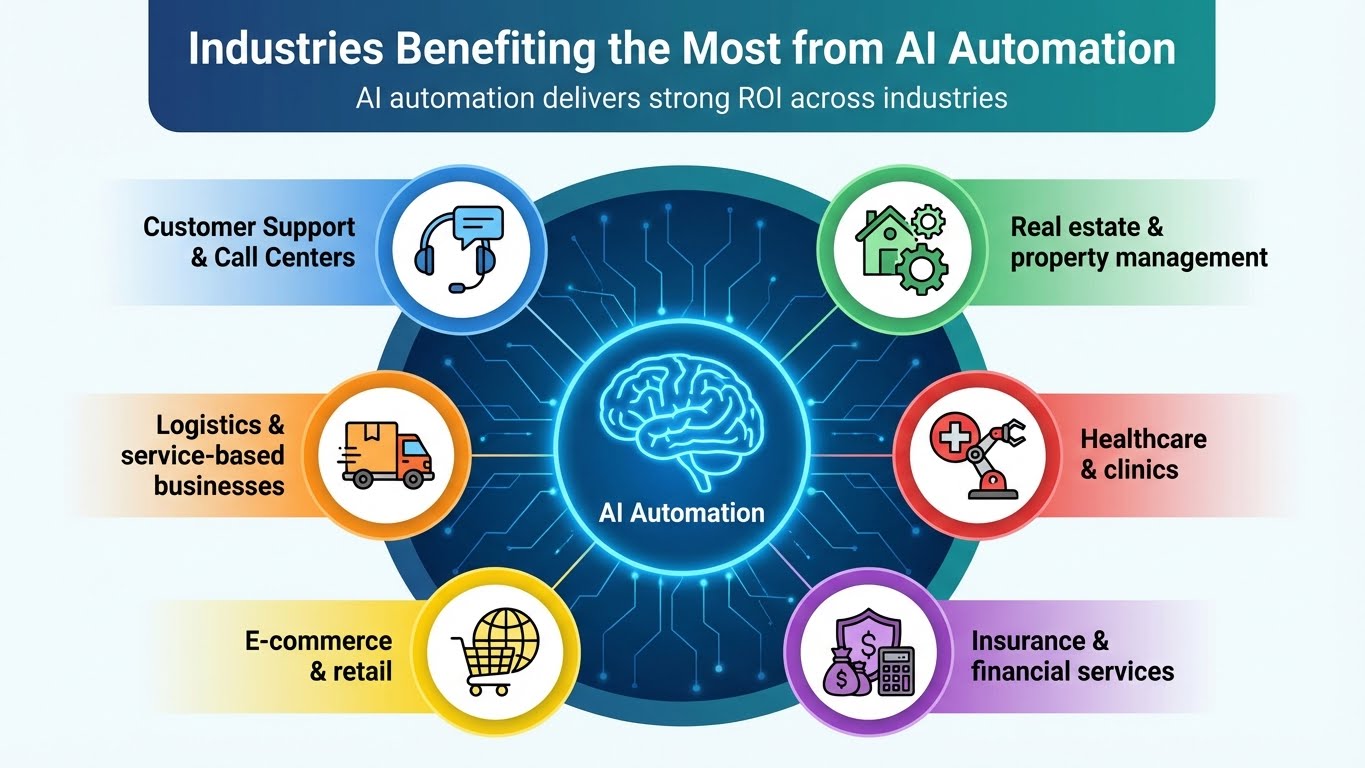
Industries Benefiting the Most from AI Automation
AI automation delivers strong ROI across industries such as:
Customer support & call centers
Real estate & property management
Healthcare & clinics
Insurance & financial services
E-commerce & retail
Logistics & service-based businesses
Any industry with high interaction volume or repetitive workflows can benefit significantly.
Industries Benefiting the Most from AI Automation
AI automation delivers strong ROI across industries such as:
Customer support & call centers
Real estate & property management
Healthcare & clinics
Insurance & financial services
E-commerce & retail
Logistics & service-based businesses
Any industry with high interaction volume or repetitive workflows can benefit significantly.
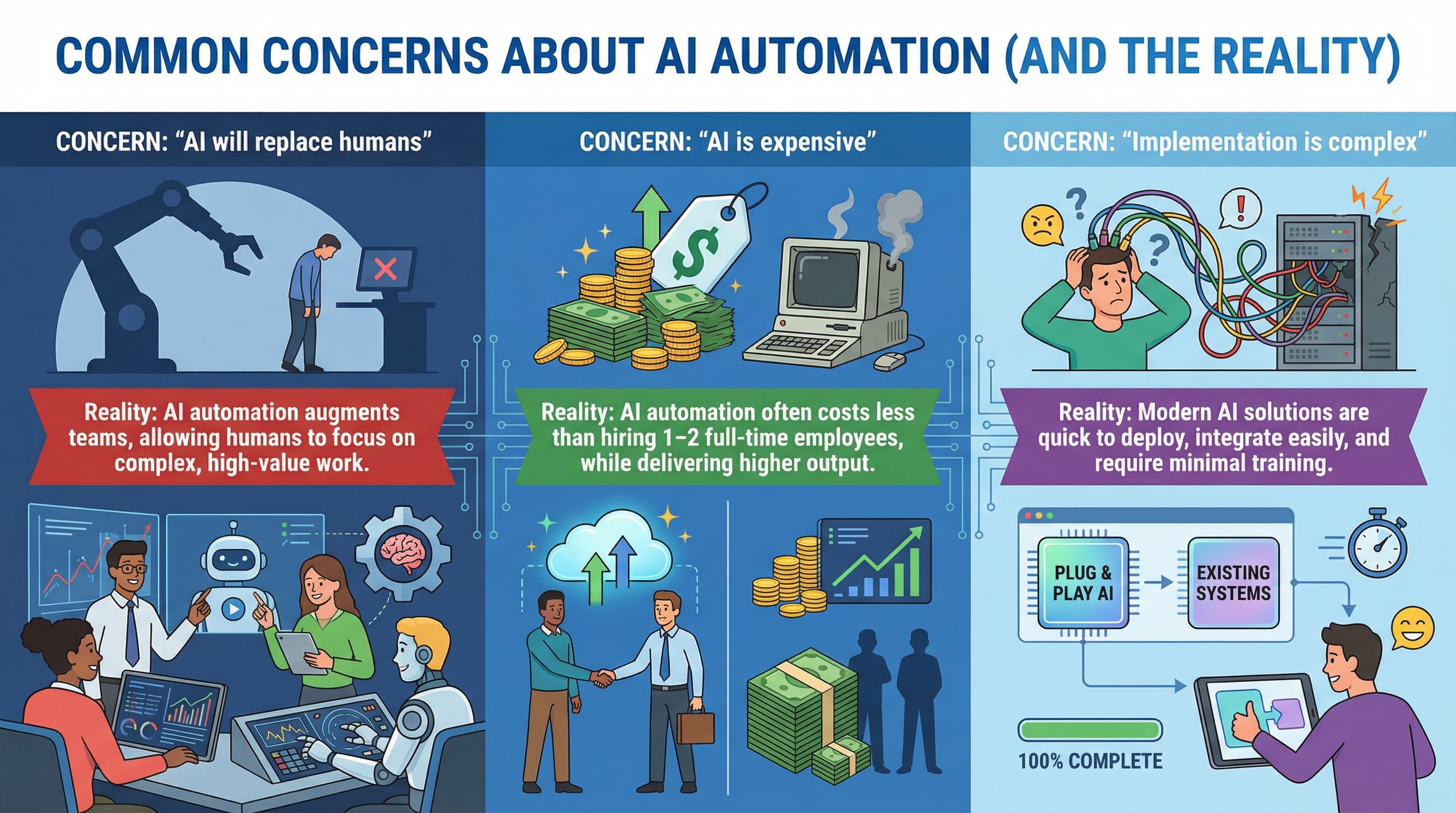
Common Concerns About AI Automation (And the Reality)
“AI will replace humans”
Reality: AI automation augments teams, allowing humans to focus on complex, high-value work.
“AI is expensive”
Reality: AI automation often costs less than hiring 1–2 full-time employees, while delivering higher output.
“Implementation is complex”
Reality: Modern AI solutions are quick to deploy, integrate easily, and require minimal training.
Common Concerns About AI Automation (And the Reality)
“AI will replace humans”
Reality: AI automation augments teams, allowing humans to focus on complex, high-value work.
“AI is expensive”
Reality: AI automation often costs less than hiring 1–2 full-time employees, while delivering higher output.
“Implementation is complex”
Reality: Modern AI solutions are quick to deploy, integrate easily, and require minimal training.
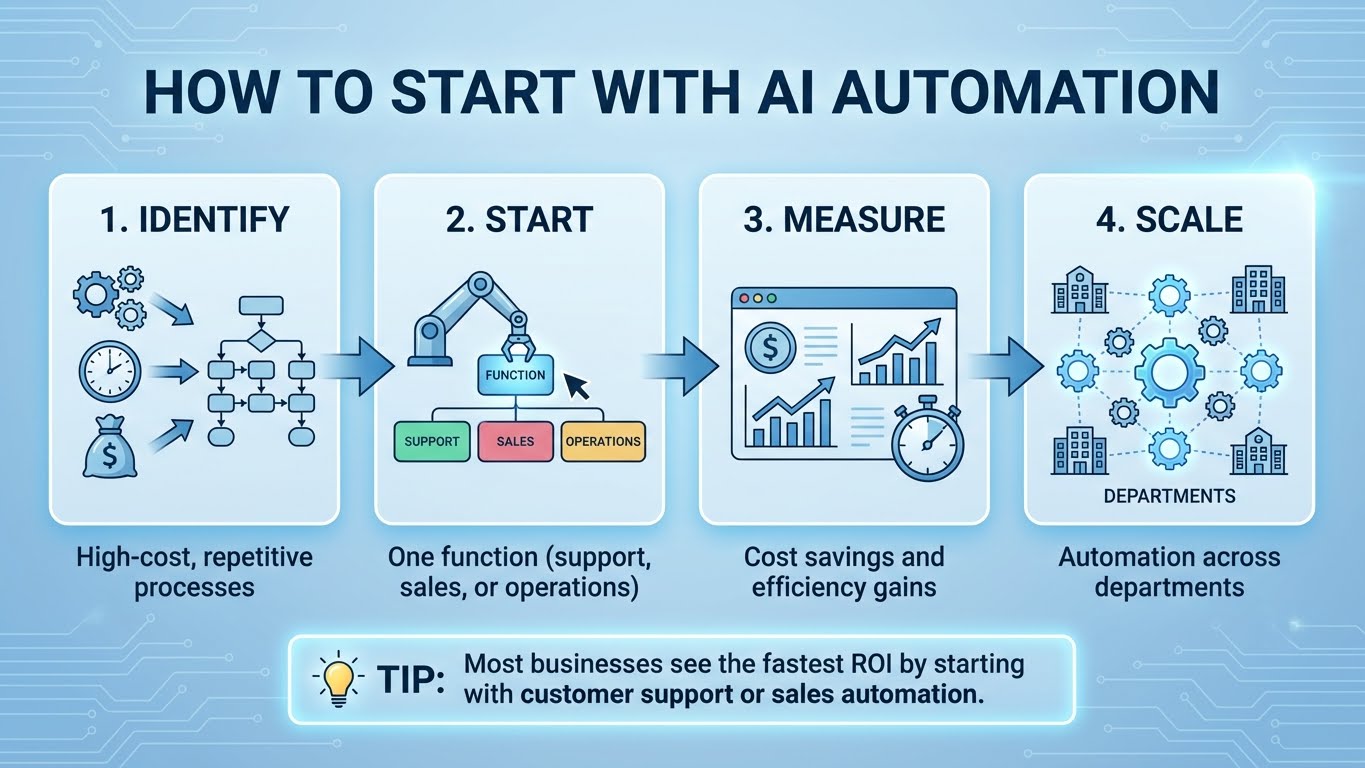
How to Start with AI Automation
For businesses exploring AI automation, the most effective approach is:
Identify high-cost, repetitive processes
Start with one function (support, sales, or operations)
Measure cost savings and efficiency gains
Scale automation across departments
Tip: Most businesses see the fastest ROI by starting with customer support or sales automation.
How to Start with AI Automation
For businesses exploring AI automation, the most effective approach is:
Identify high-cost, repetitive processes
Start with one function (support, sales, or operations)
Measure cost savings and efficiency gains
Scale automation across departments
Tip: Most businesses see the fastest ROI by starting with customer support or sales automation.

Final Thoughts: AI Automation Is a Competitive Advantage
AI automation is no longer optional for cost-conscious businesses. It’s a strategic advantage that enables organizations to:
Reduce operational expenses
Scale without increasing headcount
Improve customer experience
Compete effectively in fast-moving markets
Businesses that adopt AI automation early gain a compounding cost advantage, while late adopters struggle to compete on speed, margins, and efficiency.
For decision-makers, the question is no longer if AI automation should be adopted—but how fast.
To explore related insights, you may also find these articles helpful:
Final Thoughts: AI Automation Is a Competitive Advantage
AI automation is no longer optional for cost-conscious businesses. It’s a strategic advantage that enables organizations to:
Reduce operational expenses
Scale without increasing headcount
Improve customer experience
Compete effectively in fast-moving markets
Businesses that adopt AI automation early gain a compounding cost advantage, while late adopters struggle to compete on speed, margins, and efficiency.
For decision-makers, the question is no longer if AI automation should be adopted—but how fast.
Frequently Asked Questions
Here are answers to some frequently asked questions. If your question isn’t listed, please contact us. We’re happy to assist!
1.
How does AI automation help businesses reduce operational costs?
1.
How does AI automation help businesses reduce operational costs?
2.
Which business functions deliver the fastest cost savings with AI automation?
2.
Which business functions deliver the fastest cost savings with AI automation?
3.
Is AI automation cost-effective for small and mid-sized businesses?
3.
Is AI automation cost-effective for small and mid-sized businesses?
4.
How quickly can businesses see ROI after implementing AI automation?
4.
How quickly can businesses see ROI after implementing AI automation?
5.
Does AI automation impact customer experience or service quality?